
In December of 1891, the New York Central and Hudson River Railroad selected the Buffalo area as the location over other potential sites near Rochester, Syracuse or Albany for a major manufacturing operation intended to allow the company to construct its own locomotives and components. In mid-January of the following year word leaked that the company, through a subsidiary, was in the process of purchasing some 1200 acres of land on either side of Transit road in the towns of Cheektowaga and Lancaster and running from just north of present Rehm road to as far south as present Como Park boulevard, and from present Dick road on the west to present Belmont street on the east. The tract was a very irregularly shaped set of parcels, largely accounting for the irregular boundaries of the present village. In March of 1892, the “Depew Land Improvement Company”, a stock company, was formed to manage the works, comprised of a mixture of Buffalo investors and well connected railroad men.

Included in the company’s plans were the construction of a considerable amount of housing for the anticipated workforce of many hundreds as well as construction of the structures for the New York Central Locomotive Works and the Gould Automatic Car Coupler Company, the primary establishments locating there. Indeed, what it envisioned was a full-fledged ‘company town’ with provisions for a new railway station, hotel, shops and supporting manufacturing operations. They hoped that the new community might be incorporated in time as a city, and named the project “Depew” in honor of Chauncey M. Depew, the president of the railroad from 1882 to 1898.
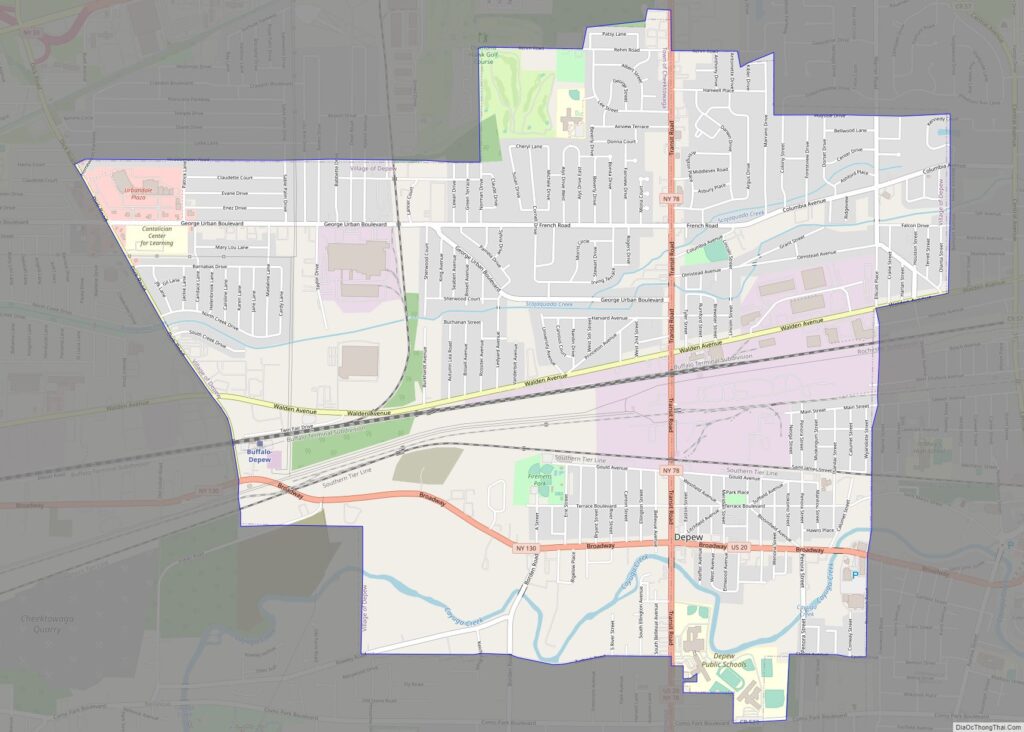
The Depew Land Improvement Company purchased 910 acres of land north of the New York Central tracks and another 190 on their south side. Substantial sections were set aside for what would become the residential portion of the village, with the remaining lands were reserved for industrial use. Construction of the huge new New York Central locomotive works on the north of that railroad’s tracks and the equally large Gould Automatic Car Coupler Company on the south commenced very quickly, with a combined expected workforce of many hundreds each. Other factories to produce steel locomotive tires, railroad car springs, railroad car springs, and other heavy industry were also being built or planned. In February of 1893, the first post office for Depew was established. Eighteen months later, on July 23, 1894, Depew was incorporated as a village, located partially in the town of Cheektowaga and partially in the town of Lancaster.
The firm of Olmsted, Olmsted and Eliot, landscape architects, was engaged to lay out the streets for the village by the Depew Land Improvement Company, the corporate entity responsible for the project’s development. Olmsted provided several drawings to the company, covering the several residential divisions of the properties, not all of which were contiguous. The layouts were complicated not only by the usual corporate desires for economy, but by multiple other land combines and the desire of a few farmers to hold out for a bigger payday. The work was fairly detailed, down to street and planting specifications, but few drawings other than the street and lot layouts have survived.

There quickly become very much a land rush with a dizzying array of syndicates snapping up the remaining area farms. Almost of the syndicates sported names with included some form of “Depew”. Olmsted had no hand in the planning the layouts of those speculative ventures, but he was requested to align the streets of his plans as much as possible with those of the other ventures.
The Panic of 1893 (the depression which lasted for eight months that year and adversely affected both credit availability and railroad growth) slowed, but did not halt, the development of Depew. Growth continued, both in housing and in manufacturing. The financial pressures on the investors in the Depew Land Improvement Company, however, were rather severe. In June of 1895, a small group of New York City investors made a sudden acquisition of the heretofore largely Buffalo backed company.
After that change of ownership, Depew’s growth continued, and the Depew Land Improvement Company remained the prime driver of its growth. However, with the departure from the firm of J. J. Albright and his close ties to Frederick Law Olmsted, the interest in continuing to implement all of the Olmsted designs for the village departed with him.


260509