The southern portion of Buffalo was rapidly expanding in the 1880s, but was distant from the existing parks and parkways of the city. In response to requests for a park which would be more conveniently located for the residents of South Buffalo, the park board solicited Frederick Law Olmsted‘s assistance in selecting a site for a new park. In 1888, Olmsted prepared a design for the new grounds, his original South Park proposal. He suggested the new park be located on the Lake Erie waterfront at the southerly city line. This proposal to the Park Board would have added a second true “park” (in Olmsted’s sense of the term) to the Buffalo park and parkways system. At that time, no other city had more than one such space. It would also have been the first Buffalo park with waterfront access.
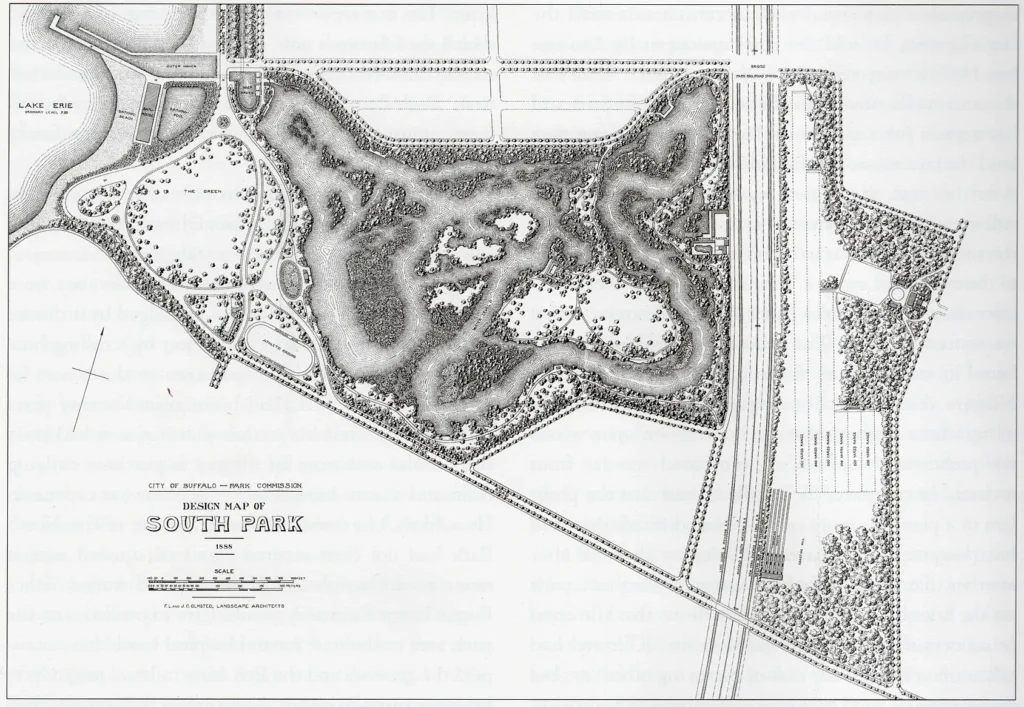
The proposed park, which would have occupied a site of over 240 acres, was also to have provided space for more active forms of recreation than then available at what is now Delaware Park. To give an idea of scale, the proposed new park would have been just a bit larger than that part of present Delaware Park, the “meadow” part and zoo, north of the Scajaquada Expressway.
A twenty acre greenspace called “the Green” was intended as both a play area and a location for periodic mass amusements. A bathing beach was to be established on Lake Erie, with a commodious beach house, and with a separate sheltered bathing pool on its landward side. Along the park’s southerly edge an athletic field of three acres, complete with running track, was proposed. The largest portion of the park, about 180 acres, was to be occupied by a lagoon with multiple islands. The largest of the islands would be over 20 acres in area, connected with the land by a footbridge. This island would be used as a picnic ground, with the adjoining canals used for boating.
Olmsted proposed that the several railroads which ran to the east of the site should be consolidated. A viaduct over their rights of way would then provide carriage access to the park. He suggested that a passenger train station be located at the viaduct, thereby providing an alternate means of access from the city proper. He also suggested that a ferry service could be established from downtown to the site along a nearly four mile long combination of a canal and a levee. To the east of the relocated railroad tracks, he suggested constructing a firing range for the use of the local militia. A toboggan run and sledding hill would share that space for winter use, with the firing range deliberately flooded and used for ice skating.
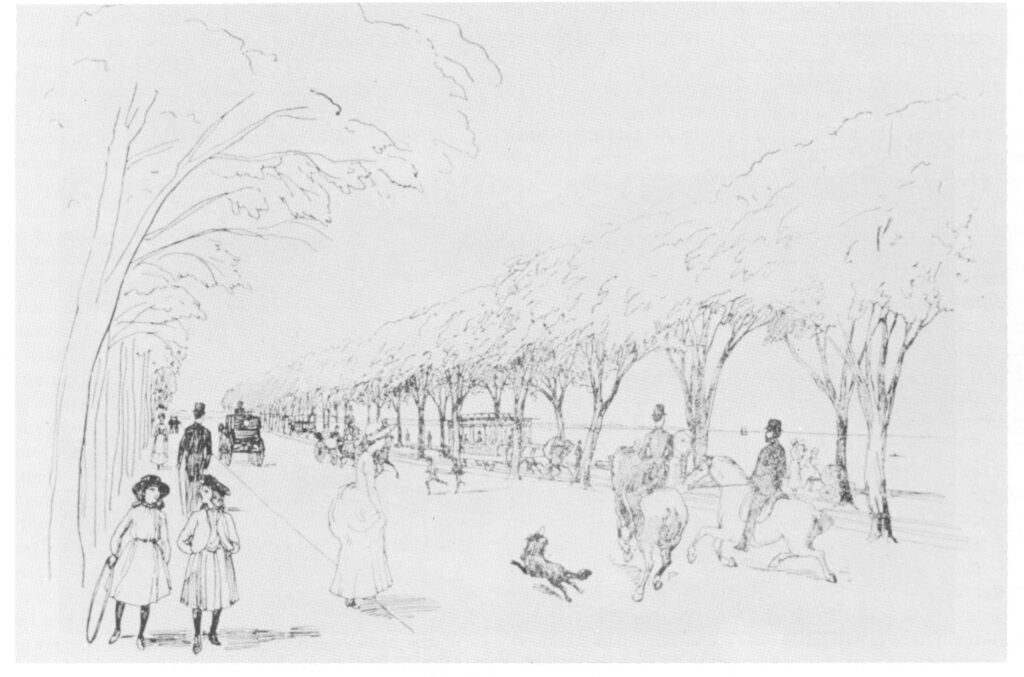
His dramatic plan was reluctantly turned down by the Park Board after a lengthy and spirited period of public debate due to its expected high cost and the perceived difficulties of maintaining the low-lying site. Erosion from the periodic, and indeed sometimes ferocious, storms blowing in off Lake Erie were a significant concern.
The Park Board still considered the need for a park in the southern portion of the city to be of great importance, but it proved quite difficult for them to locate an appropriate alternative site. It was finally decided to construct two separate but complementary grounds of smaller size (Cazenovia Park and the present South Park), connected by parkways, instead of a single large park. Unlike the original plan for South Park on the lake shore, which would have met Olmsted’s considerations as a true “park”, the two parks as constructed were not sufficiently large and individually entailing all of the varied features needed to meet Olmsted’s “park” criteria. They also failed to capitalize on the unique association that Lake Erie offered to Buffalo that the proposed 1888 plan would have secured.
260213