The Terrace Parks, situated between Upper Terrace and Lower Terrace Streets, were a pair of adjoining public grounds for which Frederick Law Olmsted prepared landscape designs in 1887. The grounds located between Court Street and Church Street, with West Genesee Street separating the two. Their sites, along with all other public parks and squares, had been placed under the control of the Buffalo Board of Park Commissioners the year preceding. These grounds had been public space for a number of years and originally extended southwest past Seneca Street as far as to Lock and Exchange Streets. By this time, however, the sections lying between Church Street and Seneca Street had been given over to railroad rights of way, so that only the sections between Court and Church Streets were available to be placed under control of the Board.
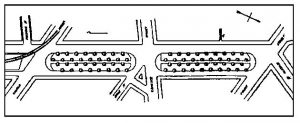
Given the difficulties posed by the site, Olmsted initially prepared three plans for the Terrace Parks, with the intention that the Park Board make the choice as to which would be undertaken. One plan was rejected because it was thought that there would be a tendency for users to cut across the grass plats, making maintenance costly. It had provided for parallel foot paths with two rows of trees flanking each walk. A second design was found unacceptable because the railroad (which owned property adjoining the Lower Terrace) was unwilling to sell a portion of its property necessary for a street widening required by this plan. The second design would have made the parks more narrow than the other two proposals, allowing only two rows of trees to be planted. The third design, which the Park Board adopted, featured seventy-six elm trees planted in four rows, arranged along a 61′ wide central area of grass bisected by a 6′ wide flagstone footpath. Similar 6′ wide flagstone walks, set back 10′ from the curb line, ran around the circumference of each park. Stone copings, 18 inches high and topped by a railing, protected the turf from the trespasses of pedestrians.
The Park Commissioners had a considerable amount playground equipment installed and a lavatory building erected in 1901 as they shifted the purpose of the Terrace Parks to one of active recreation rather than a passive greenspace in the midst of their very urbanized setting. The initial playground equipment was further augmented over the next few year. The new direction for these parks necessitated the removal of much of the landscaping and permanently altered their appearance, and erased much of the Olmsted design. Fifty years later, the construction of the New York State Thruway in 1951 and, later, the construction of the elevated Skyway Bridge over the Buffalo River, destroyed nearly all of what remained of the parks. Slight vestiges now remain, primarily at the end of the Lower Terrace at West Genesee Street, near the new downtown post office. A small portion of the stone coping and central walk are still visible there.
260213