Parkways, Avenues, Places, and Circles
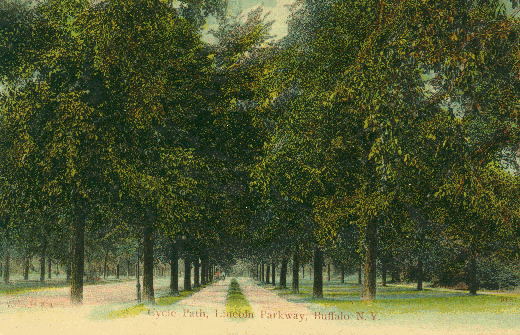
The unique feature of the original Olmsted park system plan for Buffalo was the extension of the park experience well beyond the confines of the acreage set aside for park grounds through a system of connecting parkways. The so-called Park Approaches of the original system consisted of four “parkways”, which were 200 feet in width and totaled 3 miles in length, and three “avenues”, which were 100 feet wide and totaled 4 miles in length. Combined, the park approaches added about 125 acres of parkland to the city. The parkways (Chapin, Bidwell, Lincoln and Humboldt) were each designed with two separated drives, wide greensward spaces, pathways, and several rows of trees. The trees were specifically chosen so as to provide uniformity of species and age, and were planted equidistantly along each row. The longest of the four, Humboldt Parkway, extended for over 1-3/4 miles, linking “The Park” (now Delaware Park) and “The Parade” (now Dr. Martin Luther King, Jr. Park) via a magnificent swath of greenspace. The “avenues” (Richmond Avenue, originally called simply “The Avenue”, Porter Avenue and Fillmore Avenue, originally called the “East Side Boulevard”) each had a single drive and no central planting space, but were lined by uniformly planted trees on each side of the roadway, which was set well off from the adjacent residential lot lines.
The Buffalo park approaches were significant in that they were constructed, maintained and controlled by the Buffalo Board of Park Commissioners, not the regular city authorities. The Board prohibited commercial traffic, and was also able to exert significant control over where normal city streets could access the major parkways. Commercial businesses were also restricted from being established along the approaches, with the Board also able to regulate signs and similar non-residential aspects of these special parts of the Buffalo park system. Delaware avenue, it should be noted, was not an Olmsted design and has never been part of the city’s park and parkway system. Despite the prominent residences which once lined this thoroughfare, it has always carried commercial traffic and was not subject to Park Commission regulation. (The park approaches of the later extension of the park system south of the Buffalo River are separately addressed elsewhere in this website.)
The Places and Circles
On the park approaches, several important street junctions were specially laid out and landscaped under the Park Board’s control, with Olmsted specifying their designs. The “places” were all rectangular in shape, while the “circles” were as their name describes.
Soldier’s Place, which was subsequently (and confusingly) renamed as Soldiers Circle when its roadways were altered, is at the junction of Lincoln, Chapin and Bidwell Parkways. It was the largest of the places and circles, fully 700′ across. It was intended specifically as a space to contain a monument to honor the veterans of the recent Civil War, but the monument envisioned for emplacement there did not come to fruition.
Bidwell Place, 510′ x 465′ in size, is now called Bidwell Circle after its revised roundabout traffic pattern, changed at the same time as Soldiers Circle was altered. It is located at Bidwell Parkway and Richmond avenue.
Chapin Place, 500’x 420′ in size, is now known as Gates Circle and is at the southern terminus of Chapin Parkway where it joins Delaware avenue (once called Delaware street.) Chapin Place (and Chapin Parkway) were named for Col. Edward Payson Chapin (August 16, 1831 – May 27, 1863), a Buffalo attorney and Civil War officer killed at the Battle of Port Hudson, Louisiana; he was posthumously promoted Brigadier General. Chapin Place today is not as it was designed by Olmsted. It was re-named Gates Circle after its central portion was redesigned in 1902 by Buffalo architects Green and Wicks in the Beau Arts style to accommodate a granite fountain and seating in its center. It was renamed in honor of Mr. and Mrs. George B. Gates, the parents of Mrs. Charles W. Pardee who donated the funding for the redesign.
Symphony Circle, (originally simply called “The Circle”), is 500′ in diameter and is located at the junction of Porter and Richmond avenues.
Agassiz Circle, now greatly modified by the expressway projects of the 1950s and 1960s, is 490′ in diameter and is at the junction of Humboldt Parkway, the carriage concourse of Delaware Park, and Parkside avenue.
The two smallest of the original Olmsted circles were 300′ in diameter:
Ferry Circle is at the junction of Ferry Street and Richmond Avenue. Its center island had been removed, but restored
“The Bank”, no longer existing, was at the junction of Sixth street (now Busti avenue), Massachusetts street, and Niagara street. Later, a connecting park drive, Sheridan Terrace, also entered The Bank, linking it to The Front via a strip of land ceded by the Federal government across the periphery of the Fort Porter grounds.
All of the places and circles had center planting spaces, which added green space to the vista down the roadways entering them, breaking the appearance of unending pavement as one traveled the thoroughfare. They also provided extra setbacks for the houses built along their periphery, with sweeping walkways nestled amidst trees.

The Avenues and Parkways
The park approaches served both as a means for a visitor to travel from one point in the parks to another without ever leaving the park setting, as well as an extension of the park system to a large portion of the city, in that a resident who might have had to travel a considerable distance to visit one of the three major park grounds could rather easily walk to one of the parkways to partake of a portion of the experience or reach them by a streetcar ride.
Changes
Just as the City Beautiful movement brought monuments and large structures to Delaware Park, so too it affected the park approaches. As mentioned, Chapin Place, as designed by Olmsted, was lost when it was completely redone as Gates Circle in the Beaux Arts fashion. Olmsted’s layout was supplanted by a large fountain and pool with granite walls and seating. Bidwell Place and Bidwell Parkway had both been named for Brigadier General Daniel Davidson Bidwell (August 12, 1819 – October 19, 1864), who was mortally wounded at the Battle of Cedar Creek, Virginia. He was the senior local Army officer to be killed in the Civil War. Bidwell Place later was renamed as Colonial Circle. An equestrian statue of General Bidwell by sculptor Sahl Swarz was installed in Colonial Circle in 1924, an installation unanticipated by the original design. Soldiers Place underwent a name change, to the current designation Soldiers Circle, reflecting that several years after it was first opened its roadway was redesigned and its central planting area reduced while the outer planting areas were considerably enlarged. It was felt that traffic was having difficulty transiting the space under Olmsted’s original plans. In 1897, Soldiers Circle also received a display of four large naval parrot rifles mounted on carriages and flanked by stacked cannon balls. Colonial Circle also had similar guns and projectile displays. (The cannon and projectiles were removed from Colonial Circle in 1936 and from Soldiers Circle in 1937.)
After 1916, when the functions of the park board were assumed by the city directly, many of the protections afforded the parkways were reduced or were more easily circumvented. Greater access to automobile traffic was granted as the use of automobiles increased. Declared a threat to motorists, the cannons and ammunition stacks were removed from Colonial Circle and Soldiers Circle in 1936 and 1937, respectively, and relocated to Front Park. Eventually, the center islands of Ferry Street and Agassiz Circles were removed and that of Symphony Circle reduced in size to help facilitate vehicular traffic flow.
Destruction of the Parkways
After World War 2, major changes were made to the street and roadway network of Buffalo and the surrounding area, changes which were echoed throughout New York State. The new changes made the alterations outlined above seem inconsequential. The story of what was the outright destruction of the main parkways is contained here.
The Present
The resurgence in interest in Buffalo’s Olmsted parks which blossomed in the 1980s and 1990s has had a positive impact on the Olmsted park approaches. Street lighting was changed, beginning with the original parkways, to special ornamental fixtures. The missing center islands of both Symphony Circle and Ferry Circle were restored in 2002. The work included replacement of the center islands and replication of the central light standards. The speed limit on the Scajaquada Expressway, following a tragic accident which resulted in a fatality of a young park visitor, was reduced to 35 miles per hour east of Grant street, and other traffic calming alterations to the roadway were installed. Still in limbo is a proposed action to rebuild the roadway and restore it to full parkway status. Agassiz Circle has not benefited, however, and any improvement to its condition is going to be dependent on completing the restoration of NY Route 198 as a parkway. New York State Department of Transportation, in conjunction with an impending reconstruction of the Kensington Expressway, proposed decking over a portion of the highway in a partial restoration of the old Humboldt Parkway. It would retain the highway at six lanes, but cover the depressed section, creating a 4,150 foot long pair of tunnels between Sidney Street and Dodge Street. The proposal had a major flaw: it claimed that there would be no significant environmental impact. A lawsuit brought by the project’s neighbors successfully challenged that assertion, and the project is on hold with the neighboring community demanding a full surface restoration of the parkway as near to its “as built” status as possible.
Traffic projects were to wreak havoc on the Olmsted parks after the Second World War. A 1946 traffic master plan was the genesis. It proposed several arterial expressways to speed traffic into, out of and around Buffalo. For a time, the plan was only a proposal. But, in the 1950s, that plan was ‘dusted off’, updated, and then acted upon. The first impact was on the section of Humboldt Parkway from Monticello and Eastwood Places east to Crescent Avenue; that portion of the parkway was excavated to pass as a 60′ wide highway under Main Street and Kensington Avenue. The plan was finalized in late 1950, but strong opposition to the destructive impact on Humboldt Parkway blocked the project for over a year. Construction eventually won out, and the bypass was opened to traffic in October of 1952. Then, the 3.2 mile long Scajaquada Expressway (NY Route 198) began construction late in the 1950s, and was opened to traffic on 8 Dec 1959. It runs as a 4 lane limited access divided highway from the Niagara Section of the New York State Thruway (Interstate Highway 190) along over the southern bank of Scajaquada Creek, and for some distance over it as a significant portion of the creek new feeds into a tunnel. It replaced the carriage drive of Delaware Park, serving as barrier dividing the magnificent Delaware Park into two sections. It then continues below grade along the western segment of Humboldt Parkway. It was intended to provide a crosstown connection from the Thruway to the Kensington Expressway and thence to downtown or to the main section of the New York State Thruway and to the Buffalo Airport.
Connecting to the Scajaquada Expressway is what came to be known as the Kensington Expressway (NY Route 33) begins downtown and leads to the Buffalo Airport in Cheektowaga, mostly as a below grade, six lane, arterial highway. After considerable discussion, construction began, in three phases. Noteworthy is that the destruction of the Humboldt Parkway greenway was missing from the debates. Early on, in 1960, all of the trees of Humboldt Parkway were felled. When the section from Jefferson Avenue to Harlem Road opened in 1967 the entirety of Humboldt Parkway was completely destroyed. The Humboldt Parkway trees were cut down and the parkway paved over. Moreover, it divided and ultimately destroyed the beautiful vibrant neighborhood which had been formed along its course.
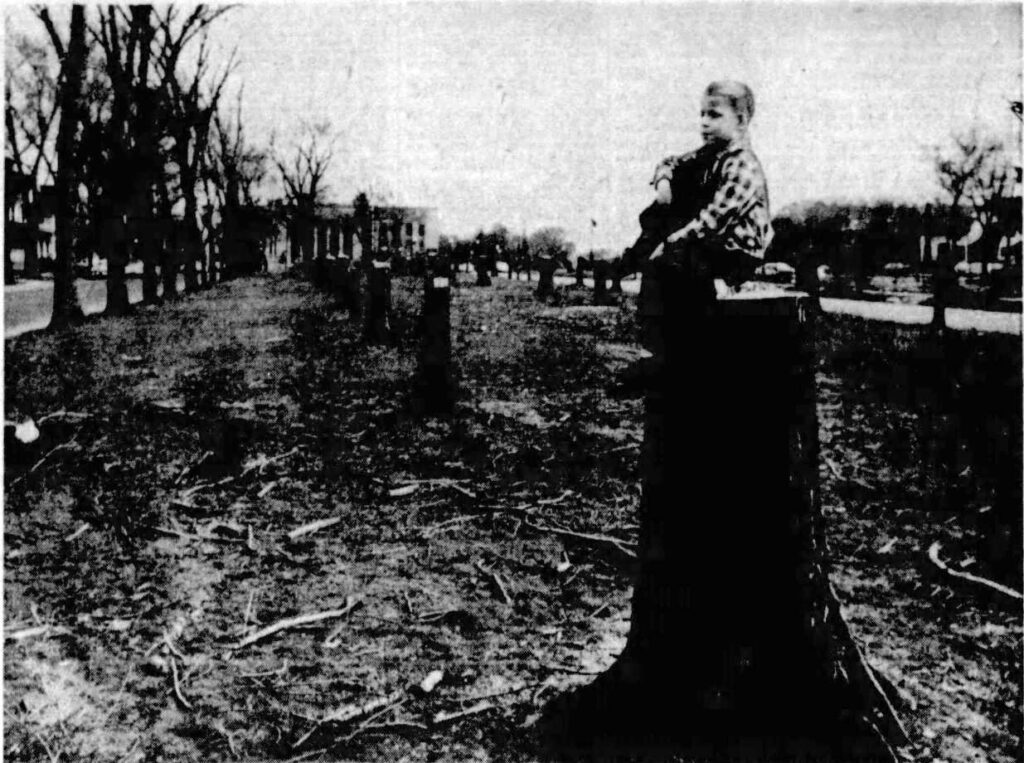
These expressways obliterated the park’s carriage drive and Humboldt Parkway, introduced major new highway access roadways into parkland, and split Delaware Park into two entities. In addition, the huge amounts of rock and soil created by the excavations of the below-grade expressways was dumped into what is now Hoyt Lake, destroying most of its North Bay as well removing much of the lake’s Olmsted-intended character.
The resurgence in interest in Buffalo’s Olmsted parks in the 1980s and 1990s had a positive impact on the Olmsted park approaches. Street lighting was changed, beginning with the original parkways, to special ornamental fixtures. The missing center islands of both Symphony Circle and Ferry Circle were restored in 2002. The work included replacement of the center islands and replication of the central light standards. Agassiz Circle did not benefit, however, and any improvement to its condition is dependent upon a restoration of Humboldt Parkway and on completing a restoration of NY Route 198 to parkway status.
250315