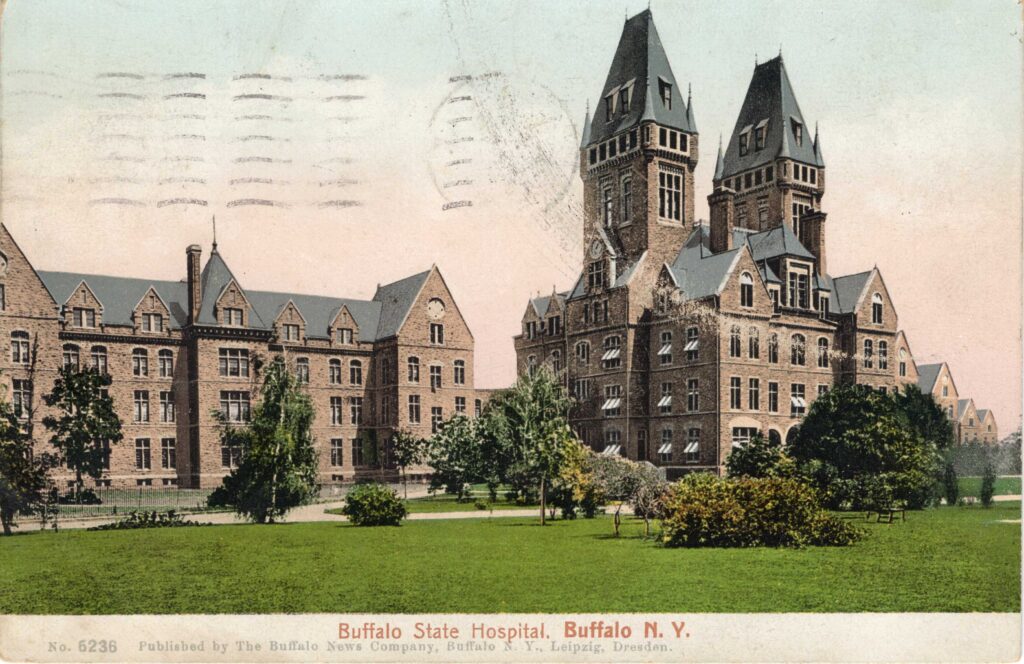
Frederick Law Olmsted was responsible for the landscaping of the New York State Asylum for the Insane (which later became the Buffalo Psychiatric Center) at 400 Forest Avenue, Buffalo. The imposing facility was designed by Henry Hobson Richardson in 1871. The original building complex consists of a central administrative building of Medina sandstone, with two towers, flanked on each side by five brick ward pavilions set progressively set back from the center. There were eleven buildings in all, connected by short, curved two-story corridors. Additional supporting buildings were set behind the main complex. The design allowed the patients to be grouped and housed based on the type and degree of their mental illness, a then-progressive system known as the Kirkbride plan. Ground was broken in 1872 and construction of the central building and the eastern wings continued until late in 1880. Construction of the five western wards were delayed. They were finally put up between 1891 and 1895.
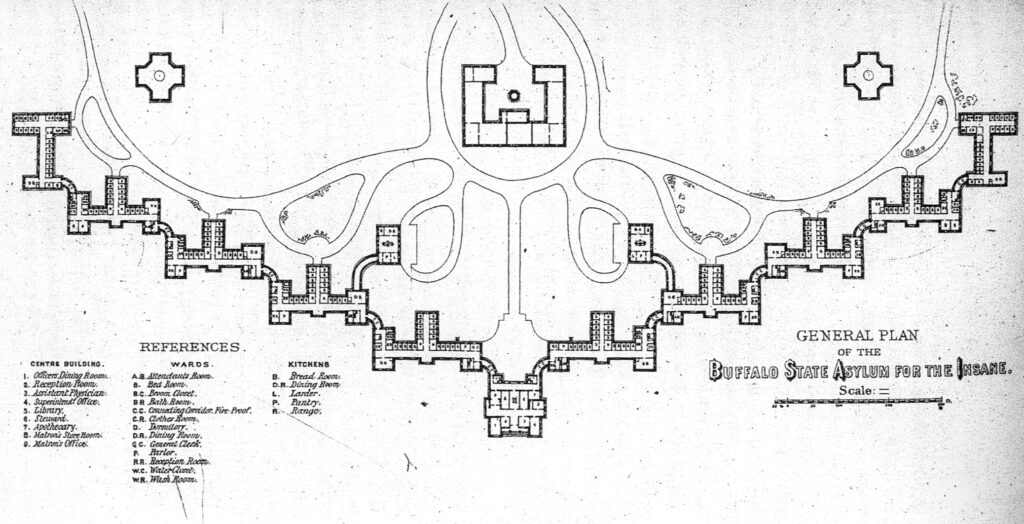
The asylum occupied 203 acres, encompassing all of the land between Elmwood Avenue and Grant Street, from Forest Avenue to the Scajaquada Creek. It included a working farm of about 100 acres, which provided both employment for and sustenance to the patients. The plantations of the main buildings provided a quiet setting and buffered the inmates from the bustle of the city. The plantings and landscaping were designed by Frederick Law Olmsted and his partner Calvert Vaux. The paths and spaces they arranged were intended to facilitate the activities and philosophy of the Kirkbride plan. They laid out the front side of the grounds as a park-like open greenspace, ringed by winding walkways. It was believed that the park-like setting with spacious and tree-shaded lawns would have a therapeutic and calming effect on the hospital’s patients. The landscape designs were partially, but not completely, implemented. Not accidentally, the extensive asylum grounds provided an augmentation to the greenspace of The Park (now Delaware Park). Forest Lawn Cemetery provided a similar service farther to the east.
In 1927 the northern (farmland) portion of the site become the campus of Buffalo State College, when the then State Normal School relocated from Porter avenue. Other significant portions of Olmsted’s plan for the site, as well as major sections of Richardson’s buildings, have been destroyed by parking lots and modern construction. The present main hospital building, the Strozzi building, was constructed east of the original complex in 1964. The three easternmost ward buildings were demolished in 1969 for the construction of the Butler Rehabilitation Center, the hospital’s adolescent treatment building. The last patients were removed from the Richardson buildings in 1974. The hospital’s administrative offices remained in the central tower until 1994. As the buildings were vacated, the State allowed them to fall into serious disrepair.
Fragments of the Olmsted landscape remain, including parts of walks and drives, and some original plantings. The portion most intact is in the frontage between the main Richardson building and Forest avenue.
The Richardson-designed buildings, while lying vacant for so many years, had been improperly secured against vandalism and weather. Despite their inclusion in the National Register of Historic Places in 1973 and designation as a National Historic Landmark in 1986, they were allowed to deteriorate. They were also listed on the National Trust’s list of twelve nationwide “sites to save” and the Preservation League’s statewide list of seven “sites to save. Repeated efforts to have New York State, as the owner, maintain and restore the property proved frustrating. Eventually, a lawsuit was filed by the Preservation Coalition of Erie County (now known as Preservation Buffalo Niagara), forcing the State to commit significant funds for rehabilitation.
Early in 2003, New York State announced the commitment of $7 million in stabilization funds to begin that process. Over the next two years, about $5 million of that fund was used to fence and secure the site, provide protection against water infiltration, including some roof and gutter repairs, cover window openings and seal the ground floor against illegal entry.
Continuing public ire at the slow pace of rehabilitation caused increased political pressure for advancing a solution. As a result, New York State in 2004 announced that it would dedicate $100 million dollars to complete the rehabilitation. Of the 91 acres at the site then under the control of the Office of Mental Health, about 40 acres were made available for rehabilitation. The Richardson Center Corporation, a public benefit corporation, was established in 2006 to administer the complex. To identify the site and differentiate it from the ongoing hospital, the name “Richardson-Olmsted Complex” was selected. Essentially, the Richardson Center Corporation’s portion is the southernmost part of the psychiatric center grounds. The New York State Office of Mental Health retains control of 41 acres, continuing to operate its treatment facilities in that portion.
In 2007, an Historic Structures Report for the complex was released. Using the remaining $2 million in funding allocated in 2003 but not yet spent, additional repairs were initiated, including masonry stabilization and additional roof repairs. In 2009, a draft master plan for the site was released, envisioning a mixed use campus, to include an architectural center (), a regional visitors center, hotel space and meeting/conference facilities. A fire occurred in 2010 causing considerable damage to portions of the structure and highlighting the need for further security improvements and greater urgency in the restoration process.
However, nearly one quarter of the state funding will not be spent to directly preserve and redevelop the Richardson complex. In a political arrangement announced in January 2006, a significant amount of the state monies were earmarked for other* projects. The sum of $76.5 million would be used for restoration of the Richardson “footprint”, mainly the central towers. Restoration of a portion of the Olmsted grounds at the front of the complex was undertaken. $20 million was to be used to create an architectural museum for tourists interested in Buffalo’s architectural history, and thereby providing the structure a compatible tenant. The architectural center was to be designated the Lipsey Architectural Center Buffalo and occupy space in the Strozzi building’s main floor. Opening was intended for 2019, but has been delayed.
The other tenant for the building was to be a small high end hotel and conference center. The Hotel Henry and Conference Center opened in April, 2017. Hotel Henry was an original-concept full-service hotel with 88 guest rooms and suites. Rooms are of varied layouts to most efficiently adapt to the buildings’ historic design. In addition, several conference spaces were offered. Business setbacks occurred and caused the hotel to announced it was closing at the end of February, 2021. Soon after, the Douglas Development Corporation took a lease of the property, with the intent to restore the remaining buildings on the campus. In March 2023, it re-opened the hotel, renaming it the Hotel Richardson. The principal of the Douglas Development came under mounting adverse business pressures. In July 2025, the Richardson Center Corporation ended its agreement with Douglas Development and began direct oversight of the hotel operations. It has contracted with a national hotel management company, Greenwood Hospitality Group, to operate the Richardson Hotel on its behalf.
Given the very long history of neglect at the site and the apparent difficulty of establishing a viable niche hotel there, there exists ample reason to remain concerned – yet hopeful – for the ultimate success of the project.
*Of the “other” $24.5 million of designated state funding, $16.5 million was earmarked for relocation of the Burchfield Art Gallery from the adjacent Buffalo State College campus. Occupying what was originally an open 10 acre portion of the psychiatric center grounds, and the Burchfield-Penney Art Center’ss 84,000 square foot gallery and administrative building is at the junction of Elmwood Aveneue and Rockwell Road. $7 million of the funding was designated to help complete the Eleanor and Wilson Greatbatch Pavilion Visitors Center at Frank Lloyd Wright’s Darwin D. Martin complex, a bit of a distance from the Richardson-Olmsted Center, on Jewett Parkway.
260210