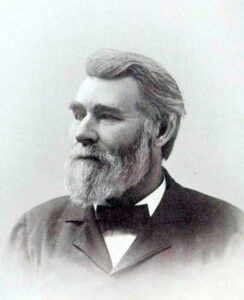
Cyrus Kinne Porter, 1828 – 1910, was born in Cicero, New York. Originally trained as a joiner, he learned architectural drawing, which secured him a draftsman’s position with the Chicago Water Works in 1853. He married Edna Marie Smith of Waterloo, Ontario at Talbot, Ontario on 4 December 1854. The following year they moved to Brantford, Ontario, where Cyrus established an architectural office with architect John Turner, a man later regarded as “The Builder of Brantford” for his prolific work there. The firm secured a number of residential and a couple of ecclesiastical commissions during the period Porter was the junior partner. By October of 1856, Porter left the partnership and was advertising his services in individual practice. Not much is known of his professional activity in that capacity, however. Tragedy came to him on 26 April 1857 when his wife died, aged 21. The Porters had one child, a son who died in infancy, apparently at approximately the same time as its mother.
Mr. Porter married Emeline Rice on 26 Dec 1859 at Townsend, Ontario. They were to have fiver children. At the 1861 Census of Canada, he was listed with the occupation of “architect” and was living in Townsend, Ontario. In 1864, he was recorded as ‘C. K. Porter, architect & planing mill proprietor’ at Villa Nova, Norfolk county, Ontario.
Cyrus Porter and his family relocated across the Niagara river in 1865, accepting a position as Buffalo as the Superintendent of Construction for the rebuilding of the American Block, a very prominent downtown structure which had recently burned down. The following year, he became a partner to H. M. Wilcox, in the firm Wilcox and Porter. Porter left that partnership after a few years, but continued to advance his career in Buffalo. He joined with several different partners junior to him: Porter and Watkins (1874), Porter and Percival (1880–1883), and Porter and Son with son Jesse Porter (1888–1910). Another son, Cyrus K. Porter, Jr., became a Buffalo-based architect in his own right. His eldest daughter, Edna, also followed in her father’s footsteps, studying architecture at Cornell University.
Some of his works in Buffalo are:
- The American Block (1866 as construction superintendent)
- Barnes and Bancroft store, 260-266 Main st. (1867, cast iron facade added 1875, destroyed by fire in 1888)
- Buffalo city firehouse #2, corner of Jersey and Plymouth streets (1875)
- A. Reynold’s residence, North street. (1876, demolished)
- Robert B. Adam House, 448 Delaware avenue (1876)
- Public School #15, Oak street near Burton alley (1876, demolished)
- Parade House, The Parade (later, Humboldt Park, now Dr. Martin Luther King, Jr. Park) (1878, demolished 1903)
- Structure was a replacement for an earlier building by Calvert Vaux and his associate Thomas Wisedell, erected 1876 and destroyed by fire in 1877. Select portions of the original building were incorporated in Mr. Porter’s building.
- Private residence, 341 Jersey street (1880)
- Young Men’s Christian Association, Mohawk and Genesee streets, (1883, demolished 1901)
- The Coal and Iron Exchange, 255-257 Washington street (prior to 1883, now demolished)
- The Cyclorama Building, 369 Franklin street (1888)
- The Builders’ Exchange (1891-1892, demolished)
- Trinity Episcopal Church, 371 Delaware avenue (1886)
- The Disciples of Christ Church, later the Richmond Avenue Church of Christ, corner of Bryant street and Richmond avenue (1886)
- St. Paul’s Episcopal Cathedral, 139 Pearl street, roof and interior reconstruction following a major fire which left only the exterior walls standing (1888)
- Plymouth Methodist Episcopal Church parsonage (443 Porter avenue)
- Enlargement, Plymouth Methodist Episcopal Church, 453 Porter avenue (1889, demolished 1911)
- (The new Plymouth Methodist Episcopal Church at the same site was designed by his son, Cyrus K. Porter, Jr. in 1911. It is now the Karpeles Museum.)
- St. Patrick’s R. C. Church, corner of Emslie and Seymour streets (1891, demolished 1982)
- Fred Eberhard and Louis P. A. Eberhardt, twin residences, Delaware avenue between Kenmore avenue and West Hazeltine street in nearby Kenmore, 1893 (the Louis P. A. Eberhardt structure was demolished in 1977)
- The William Hengerer Company store (1904, 2 story addition constructed in 1910)
- Holy Name R. C. Church, 1947 Bailey avenue (1904)
260103