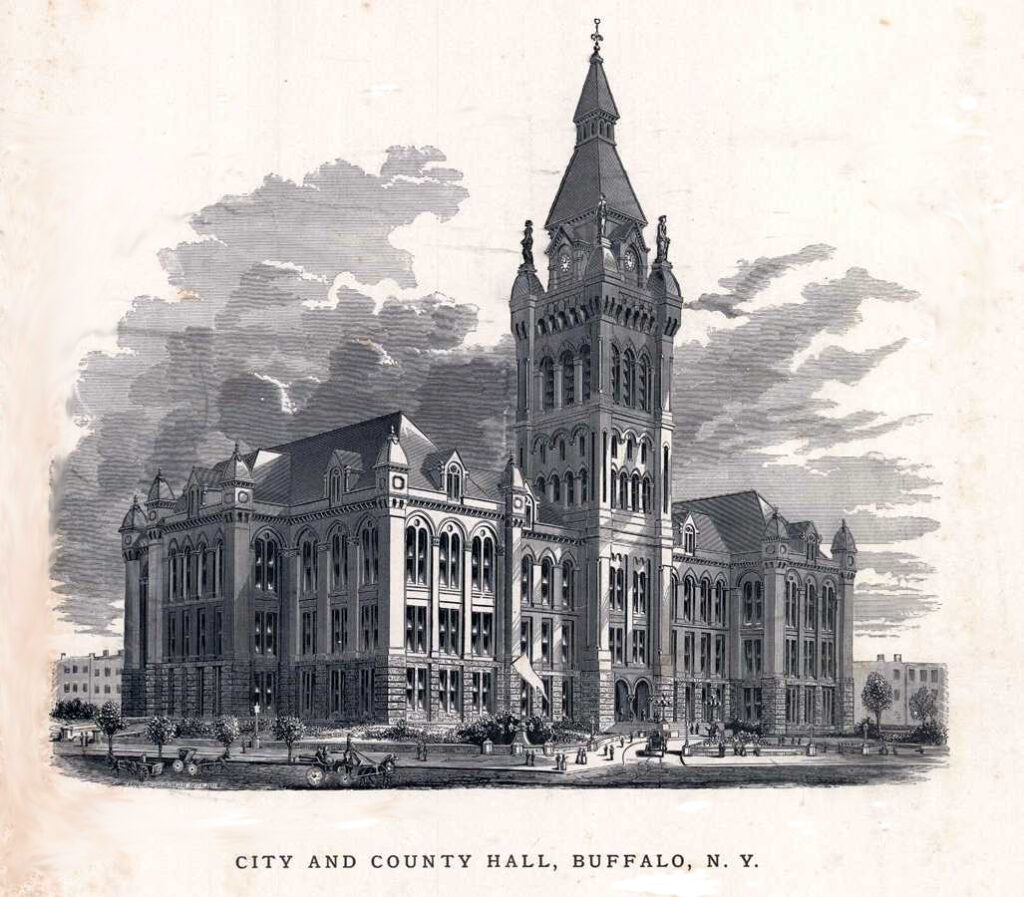
City and County Hall at 92 Franklin Street in Buffalo, now known as Old County Hall, was constructed beginning in 1871 and was dedicated in 1876. It originally housed the offices of both the City of Buffalo and the County of Erie. Andrew Jackson Warner of Rochester was the building’s architect. The building originally occupied a full city block, bordered by Franklin street on the east, Delaware avenue (then “street”) on the west, Church street on the south, and Eagle street on the north.
The building is in what is regarded as the Late Victorian Romanesque style, in the form of double Roman-style cross; opposing sides of the structure were in rough symmetry with each other. The total building length is 295′ and has a width of 158′. As originally constructed, it provided 70,767 square feet of space. The building is constructed of high quality granite, four stories tall, with 80 foot high walls and with a 280 foot tower on its east side, part masonry, part iron. A four sided clock, 9’3″ in face diameter and backlit, is set into the upper portion of the tower. Four 30 ton female granite statues, representing Commerce, Agriculture, Justice and Mechanical Arts grace the tower.
Frederick Law Olmsted was apparently invited to submit plans for landscaping the building at the behest of Dennis Bowen, a prominent attorney who was both a member of the Buffalo Board of Park Commissioners and was one of the Commissioners for the Erection of a City and County Hall. The building was nearing completion when the invitation was extended in the fall of 1875, with the structure due to open by the national centennial the following June. After some exchanges of correspondence, Olmsted provided his ideas for the site. The preliminary sketch Olmsted provided in January of 1876 was concise and clearly meant to complement the building, not to overwhelm nor mitigate its presence on the site. He was granted approval to complete a design for the grounds. He reportedly attended the formal opening of the structure on 13 March 1876, the first time he personally viewed the site. By April, Olmsted had created the formal plan for laying out the grounds. Thomas Wisedell, Vaux’s associate, was in Buffalo in that time period to supervise work on structures in The Park (Delaware Park) and The Parade (Dr. Martin Luther King, Jr. Park). He designed the stone curbing, copings, low retaining walls, end piers, long stone benches on the east side, the flagstaffs and lamps (which ended up not being installed) for the design. His designs for that stonework incorporated granite matching that of the building, and his pier caps and copings echoed the roof line features of the building’s stonework, as well.

A report published in the Buffalo Express (Buffalo, New York), Monday, May 8, 1876, page 1, provided a detailed description of the Olmsted design:
CITY AND COUNTY HALL
Plan Adopted for Beautifying the Grounds – Shrubbery, Lawns and Walks.
At a meeting held Saturday morning the Commissioners of the City and County Hall adopted a plan submitted by Fred Law Olmstead [sic] for ornamenting and beautifying the grounds about the building. The whole area of the grounds, embracing the square bounded by Franklin, Delaware, Eagle and Church streets, will be surrounded by a curbing eight inches high, surmounted by a coping-stone twenty inches wide. Within this will be a gracefully ornamented stone retaining wall, hemming in the plots of shrubbery and lawn. Sweeping in from
THE FRANKLIN STREET SIDE
will be a drive-way twenty-two feet wide, forming an arc with the outer edges opening on the street. The drive-way will be bounded by a curbing of limestone, which will separate it from a belting of sidewalk eight feet wide. Through the section of the circle formed by the drive a broad walk bisecting it will lead to the steps of the hall, and is to be flanked on each by two plots of ornamental shrubbery, thirty-one feet back from the outer line of curbing. Rows of seats for visitors will be ranged on one side of the wall enclosing this shrubbery, and the drive will swing close up close on the other. At each corner of the building another large plot of ground for trees and clusters of foreign shrubbery will be laid out and walled in the same as the others. All round the building and at a distance of [five] feet from it around another wall will be built reaching up to a level with the top of the basement windows. From the top of this area the grounds will be so arranged as top slope gradually downward.
DELAWARE STREET SIDE.
Entering the broad walk leading from Delaware street, the visitor will first come upon two large sections of cultivated lawn set with beautiful trees and shrubs and surrounded by a retaining wall the same as on
the other side. Passing on he will mount one step and reach a broad and level terrace extending near whole length of the building and overlooking the plots of lawns and shrubbery between it and the avenue. Crossing the terrace he mounts four steps to a platform from which rises the stone steps of the hall. A row of eight large elm trees will extend along Franklin street front, and a line of maples on both the Church and Eagle street sides. These plans, when carried out, will add greatly to the beauty of our City and County Hall, and make surrounding it one of the most delightful spots in the city. Work will begin as soon as the old city building is removed, and it is expected to be finished in three or four months. The
cost of thus beautifying the grounds will be about $25,000.
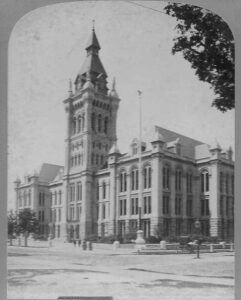
Work on the grounds had to wait until the old city hall buildings which occupied the eastern frontage of the site were fully vacated and removed. It was not until the late summer of 1877 that the landscape work was completed.

Governmental needs began to outstrip available space after about twenty-five years. In 1908, balconies and mezzanines were added to some spaces to address those needs. About the same time, elevators were added to the building.
The structure was extensively remodeled over a six year period beginning in 1925, in anticipation of the relocation of the city offices to the new city hall to be built at Niagara Square. Included was the replacement of all of the floors, the addition of fireproofing, reconstruction and rebuilding of walls, re-plastering of the interior, installation of marble tile and terrazzo, replacement of the heating and ventilating system, installation of air conditioning, and a full modernizing of the plumbing and electrical systems. The north side of the fourth floor was raised to allow for future occupancy, which also entailed removal of some of the 12 dormers and 24 turrets originally in place. The work was completed in 1931, when the last of the city offices were relocated to the new Niagara Square City Hall building. 128,864 square feet. About 1935, alterations on the fourth floor were completed. Under the supervision of Stephen L. Clergy, architect, the W.P.A. (Works Progress Administration), completed to include a library, judge’s chambers and office space. By then, the building afforded 128,864 square feet of usable space.
Space needs continued to grow, even after the city government had departed. In 1963, the present Court House Annex was constructed on the Delaware avenue side of the building, destroying the Olmsted designed landscaping on that side of the site. The other portions, however, are essentially intact.

260104