Published in the Buffalo Courier, on 6 March 1876.
THE PARK REFECTORY.
A Description of what will Prove the Centre of the City’s Play Ground –
An Elaborate, Complete and Tasteful Bit of Architecture.
Those of our citizens who, for the past few seasons, have been in the habit of spending considerable time in and about such portions of our new park as are partially or nearly complete, along its drives, or upon the waters of the pretty little lake, who, when the park is mentioned, think only of the western and northern sections of our city’s pleasure grounds – are probably not fully aware of one of the great attractions, or what is to constitute such over on the east side,
AT THE PARADE.
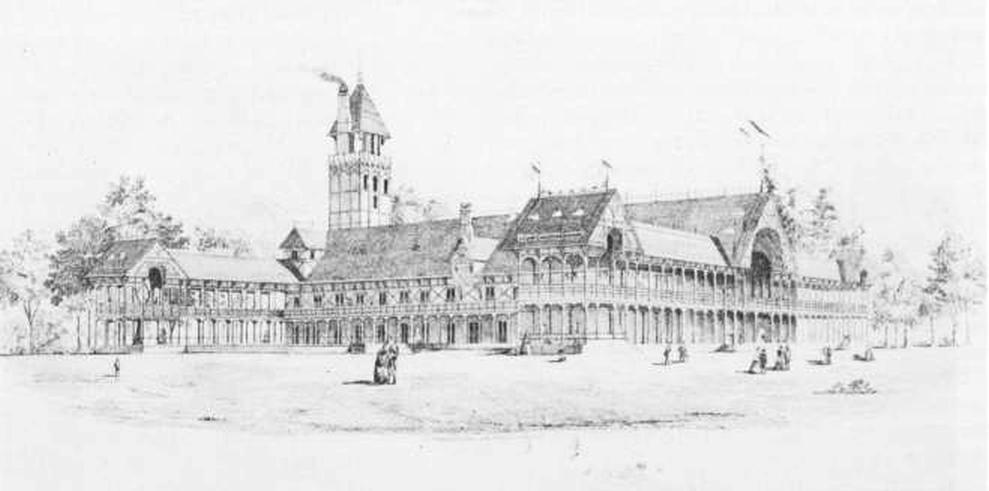
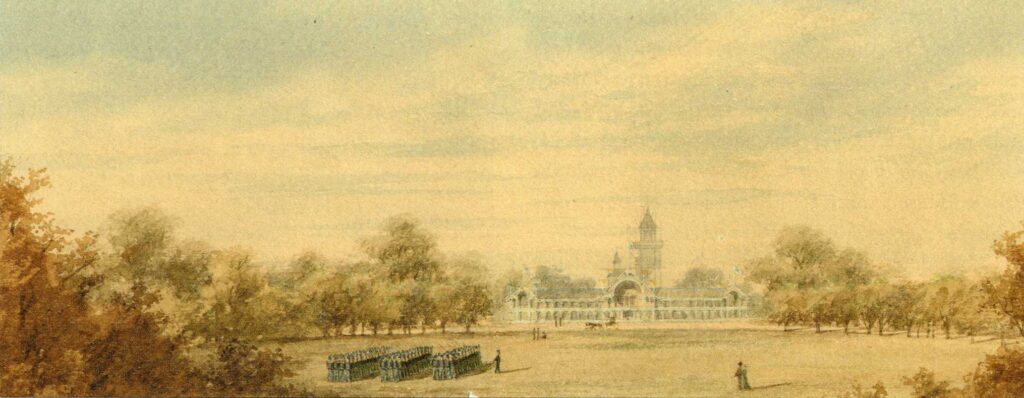
That which has been known only on paper, or at most through hearsay is the Refectory and a casual inspection of what are to constitute its many attractive features, its beauties of finish and arrangement, cannot fail to impress the visitor that our east-side brethren have, or are to have, in close proximity to them that which will be sure to attract not a few of those who are wont to spend so much of their time at the Front and the Lake. The associate of Mr. Vaux,
THE ARCHITECT
of the refectory, Mr. T. Wisedell, of New York City, arrived in this city a day or two since, for the purpose of inspecting the work on the building, as far as it has progressed in the hands of the contractor, and to lend such aid as may be necessary. Yesterday afternoon, a reporter of The Courier, in company with Mr. Wisedell, spent an hour or so visiting the refectory, at which time its details and features were fully elaborated on by the latter gentleman for the direct benefit of the public, who will be happy to learn of that which in the near future must contribute so much to their enjoyment of life.
THE REFECTORY
is built after a modern adaptation of the old English order of architecture, of decorative wood-work, the style dating back to the thirteenth century. It has a steep roof, shingled, and on one end a tower. It extends east and west, fronting to the setting sun, upon the parade; it is two hundred and forty feet long by fifty feet in breadth; the height of the structure is fifty-eight feet, while the tower at the west or rear end is about one hundred and twenty-eight feet high. From these dimensions it will be seen that the building is an extensive one, and should contain, as it will, much to add to the comfort of those it is to directly benefit. Extending across the front end, and one hundred feet beyond north and south, is a broad verandah, or ombra, two stories high, and of the same ornamental style as the general structure. It is supported by massively turned columns of pine wood, the same material being comprised throughout the Refectory, the arches between being pointed and extremely ornamental as to pattern.
ABOVE THE OMBRA
in the centre, and systematically designed with the front of the building itself, is, or will be, an elegant serrated gothic arch, twenty-eight feet in front of the Refectory proper, and just in advance of this, four feet distant, another bit of designing, of similar outlines, and all of which, taken in connection with the end of the Refectory, will combine to produce an exquisite architectural effect. The north and south ends of the extended ombra are enlarged, forming a pavillion and of great beauty. But this does not comprise the whole of the delightful verandah, which is fifteen feet wide ordinarily and enlarged to the width of twenty-eight feet in places: it extends, also, along the entire north side of the Refectory, and at the eastern extremity of the building there is another extension running north, a counterpart of that at the front end – and all of it
TWO STORIES HIGH.
It will thus be noted that on the upper side of the Refectory a large space will be enclosed on three sides by length after length of spacious, delightful ombras; and in the centre of this partially enclosed plot is to be built a circular platform, for summer, out-of-door dancing, connected with the verandah, the orchestra to be located in the upper story of the lateral ombra adjoining the refectory, and where they have a special balcony, over which there is a gablet and clock, that the dancing may not be kept up too late. On the opposite or south side of the Refectory, towards the east end, will be a private yard for the stabling of horses and the sheltering of conveyances, etc., while the other half will comprise a
BEAUTIFUL PARTERRE
for the exclusive benefit of those looking out at that side from where they may be enjoying a light lunch. Now as to the matter of tint: the ground work, or paneling of the Refectory will be shaded with cafe au lait, the framing with olive, and the shafts of columns will have a deep red color; the carving or scroll-work is to be brought into relief by black, and the mind of the artist will at once recognize this judicious use of colors. But to go inside. One may drive up from the Parade in a carriage and alight at the grand central entrance leading off from the broad flight of steps at the ombra or at one side; the pedestrian will find
ENTRANCE UPON THE OMBRA
at either extremity and along the front in close proximity to the carriage steps. The doors leading in at the east end, and just south of the Refectory, usher the visitor into a large vestibule off of which are ladies and gentlemen’s waiting-rooms and toilet apartments. Of[f] from these is the grand public dining room, a room over one hundred feet long and half as wide. It is supported by double rows of iron pillers [sic] cast in the French style, while the pilasters along at either side are constructed in a similar manner. At the front end is the bar, doubtless to be an elegant one, so arranged so as to serve directly from it to those in the room or to private parties convivially disposed out upon the ombra. Along the sides of the apartments are
FRENCH WINDOWS
reaching to the floor, and which open out, affording ingress or egress to the verandah and dancing platform. The shutters to these windows will prove a novelty, in that instead of proving in the way, they will become both useful and ornamental. While not in use the shutters are to slide along the wall in the spaces between the windows, where they will form a high paneling around the room, or they may slide before the windows and expose the warmly-tinted plastered walls, to be decorated in the future. In this room the occupants may, upon one side, glance out across the ombra, filled with gay seekers for pleasure and pastime, to the dancing platform, where may possibly be seen others similarly inclined; and those across the room will find, perhaps, equal pleasure in looking out onto the delightful little parterre before spoken of. Passing out of the general refectory, or the particular apartment denominated as such, the visitor finds his way through
A LONG WELL-LIGHTED CORRIDOR;
and this will remind him that everywhere through the building there is plenty of light, a prudent bit of forethought on the part of the designer. Off from this corridor are private dinning-rooms [sic], large private dining-rooms for a party of gentlemen, or gentlemen and ladies, smaller ones, and club dining-room, ladies’ dining and committee rooms, all complete, well lighted and opening onto the verandah, across which again may be seen the dancing platform. A passage-way also leads from the corridor onto the verandah. Parallel to, and separated by a partition from this corridor is one similar for the use of those employed in the building. At the further, southeast corner of the Refectory is the Superintendent’s private offices; next to it the kitchen,
A MODEL IN ITS WAY.
then the scullery, pantries, dummies, closets, and servants’ dining-rooms, and all of these lie opposite to, though completely separated from, the private dining-rooms of the guests. A praiseworthy feature of the arrangement here is that which allows of the serving of the guests in private dining-rooms, without collision or interference in the slightest. These rooms, all of them, as are all in the structure, will be lighted in the evening by means of an abundant supply of side-jets and pendant lights. The grand entrance to the room above is at the front end by means of a broad black walnut staircase with a liberal landing. The whole, or nearly the whole, of the upper story is converted into
A GRAND BALL-ROOM,
decidedly the best in the city, if not in the states. It is two hundred and ten feet long and fifty feet wide, arched across with deep ribs every ten feet, extending far up into the roof, forming a spacious apartment of these dimensions and thirty-five feet high, which cannot but arouse the emotions of any tripper of the light fantastic. Seats are to be provided between the pilasters supporting the arches, thus providing ample accommodation for spectators and dancers. But one of the most novel and decidedly a commendable feature in connection with the ball-room is that which admits of its being divided off, if thought best, into three or less different apartments by means of screens, seven feet high, and which may be used or discarded at will. This will prove an attraction to several different parties of dancers who may wish to occupy the floor at the same time and dance to the same music, without commingling, necessarily, and where they may, later in the evening, have supper. At the rear end of this grand hall will be placed
IN AN ARCHED NICHE
a side-board, above which is the musicians’ gallery, or alcove, and off from it is a private room where the leader of the band may treat his comrades, if so disposed, to a light lunch, in privacy and retirement. At one side is also another reception-room for the use of the ladies. On the same floor, over the Superintendent’s office, will be located that gentleman’s private apartments for the occupation of himself and his family; in fact he will have a whole house there to himself, excellently fitted up and arranged. Above, in the tower, are various other apartments to be of especial use to those engaged about the building, and the general arrangement of the upper story has been made with reference to
POSSIBLE PRIVATE THEATRICALS,
among other things, Also at this end is the light and ventilation tower which runs from the bottom to the top of the building and will prove of no small service when the Refectory is brought into general use.
IN THE TOWER,
some ninety-six feet from the ground, has been provided a fine place to gain an outlook, and those who will visit it will be surprised to learn what a fine view of the city may be obtained there. The Refectory is so built as to be entirely available, both in summer and winter, it being thoroughly heated by steam. The Walworth Manufacturing Co., of Boston, Mass., supplied the apparatus which is already in use, and at a cost of $4,500. The interior tints are to be brown and cream, and will certainly prove of a soft and warm character, tending to please the eye and conform to the general make-up of the whole.
THE CONTRACT
for constructing the entire building was let, the price being $45,000, October 16, of last year, to Joseph Churchyard, who is vigorously engaged in prosecuting the work, intending that the structure shall be “inaugurated” on the 4th of July next. From what has already been done, it appeared that the contractor had used a superior quality of material upon the building, as well as that he lost no time in pushing the work, in that he has seventy-five men constantly busied throughout the structure, besides those employed upon wood-work for the Refectory at his establishment on Clinton street. It must not be omitted in this connection, to state that the large grove just north of the Refectory, will, upon completion of the building, be converted into
AN ELABORATE PLAY-GROUND
with swings, revolving boats, bear-pits, see-saws, carrousals [sic], etc., etc. If anything in our new Park will tend to popularize its particular locality, and draw our citizens from all parts of the city to it, it must certainly prove the Refectory. It is also reported that the
EAST SIDE STREET RAILROAD
which extends almost up to the entrance to to [sic] the Refectory, will run a line of white cars during this, the Centennial year, from all connecting points on Main street, to and from the Refectory, for the special convenience of the rush of visitors who will be anxious to inspect the building.
260208