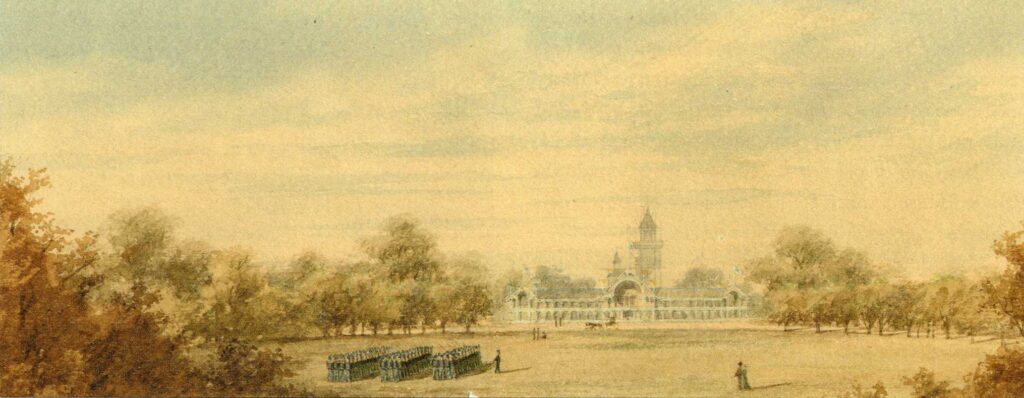
A truly spectacular public hall, the Parade House, was designed by Olmsted’s partner, Calvert Vaux, for the Parade. Originally referred to as the Refectory, its plans were first drawn up in 1870. This wonderful structure was designed specifically to accommodate the large numbers of persons expected at the large public events anticipated to be held at the grounds of The Parade. The wood structure had a marvelous two-story series of porches and galleries. The building proper was 240 feet in depth, and 50 feet in width. and was 58 feet tall at the roof line. The verandas, or porches, were 15 feet wide, enlarged to 28 feet in places to accommodate viewing of activities at the parade ground. They stretched a full 250 feet across the structure at its front and 125 feet on the northern side of the rear.
The first floor housed a restaurant 150 feet by 50 feet in size, along with a bar, private dining rooms, and comfort stations for men and women. The second floor held a grand ballroom, 210 feet long by 50 feet wide. At the rear of the building was a 128 foot tall tower with a viewing balcony. The tower portion also housed multi-level dwelling quarters for the concessionaire and his family. The verandas offered a fine site for viewing both the scenery and the military events. It was brightly painted in multiple colors: the siding was a cream color, the framing olive, and the columns red; black accented the decorative scrollwork and carvings. Blue and gold chandeliers illuminated both the verandas and the interior rooms. Fluted cast iron columns supported the dining room ceiling; the ballroom ceiling was arched, soaring some 38 feet at the peak.
Adjacent was a barn, a gravel carriage park enclosed by a wooden fence, and large carriage sheds positioned along the Best street border of the park. These accommodated visitors arriving by carriage, and street car service was available within a short distance of the structure, as well. The Parade House opened to the public on the first of July, 1876.
In March, 1876, just a few months before the building opened, a reporter for the Buffalo Courier as provided a tour of the structure. He wrote a very detailed account of his visit, available here.
The Parade House had the unintended consequence of causing considerable irritation to the larger community when the combination of musical entertainment, the alcoholic beverages served and the inviting nature of the commodious spaces for loitering it offered offending loftier sentiments. The Parade House was consistently thronged, but mostly by the local ethnic German population rather than by the attendees of drills and maneuver or larger popular concerts. Then on 26 August 1877, slightly more that a year after its opening, a spectacular fire destroyed the elaborate edifice. Fortunately, the concessionaire and his family escaped the blaze unharmed, 14 persons having been asleep in the structure when the fire broke out. After the insurance claims were settled and after considerable discussion within the Park Board, plans were made for a replacement.
When rebuilt in 1878, the new Parade House was constructed on a smaller scale and from plans drawn by a local architect, Cyrus K. Porter, rather than re-using the original Vaux and Wisedell plans. Whereas the original represented a total investment of about $60,000, the budget for the reconstruction was capped at just $15,000. The new structure, though, was still very much in keeping with the spirit of and maintained a good deal of the detail of the original design, in particular the two-floor main structure with a restaurant and a ballroom, and the front expanse of verandas. The southwest veranda of the original and a portion of the main building had survived the fire, and those were incorporated into the new building by Mr. Porter. The rear verandas, dance platform, and the tower were not rebuilt.
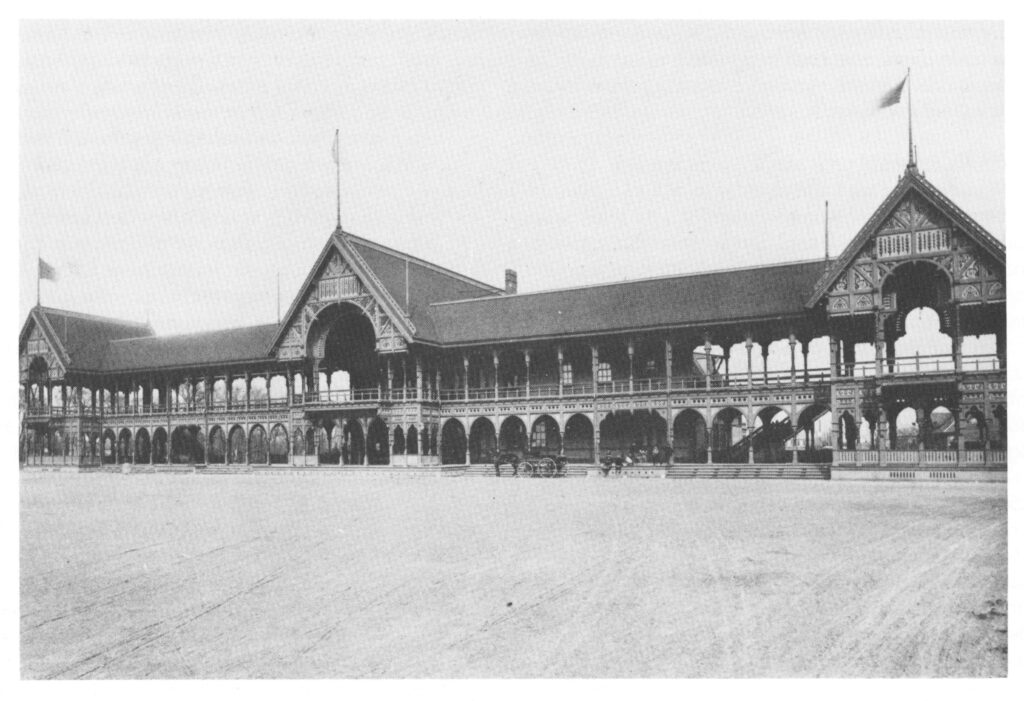
Eventually, wear and tear plus shifting use patterns led to the Parade House’s demise. The facility did maintain some regular tensions with citizens who were offended by the behavior of the patrons; this issue persisted throughout the life of the facility. In addition, in 1886, Fillmore avenue was extended across the park, effectively dividing it into two sections. The National Guard ceased any use of the grounds in 1893. The northern section of the veranda was removed in 1897, which impeded the use of the Parade House for band concerts. In consequence, a granite bandstand was erected in 1898 behind where the veranda segment had stood, addressing that need.
Finally, in 1903, the Parade House was declared obsolete. It was sold and then demolished. Local architect Robert A. Wallace was engaged to design a smaller, utilitarian, shelter house to take its place; that shelter house still serves the park today … but the grand Parade House was no more.
260111