The city had attempted to take the 10-2/3 acres of underutilized lake shore land starting in 1886. This land was located between The Front and Lake Erie, on the far side of the Erie Canal and a railroad right of way. It was occupied by some shacks and shanties and also by an ice house belonging to the Buffalo Ice Company, which was constructed on leased ground. A dispute arose when the adjuster awarded the company only the value of the unused portion of their lease, but had not awarded the compensation for the structure. An assumption had been made that the company would relocate and retain the building. The case went to court, and was not resolved until 1891. Finally, in 1893, after several years of negotiation, the title to the last of the additional parcels desired was acquired.
The land itself was not of particularly good quality and was low lying. A considerable amount of fill was needed before any construction on the site could be considered. Although the city’s primary purpose in seeking the property was to preserve the sight lines to the lake from The Front, the Board of Park Commissioners sought to move beyond that basic motive and attempt to make a beneficial and attractive use of the plot.
The Board invited Frederick Law Olmsted, who had viewed the parcel in the course of his earlier work creating The Front, to prepare a design for the property. Olmsted suggested that a great deal of the property be used for active recreational activity, supplementing the more passive use of The Front proper. He submitted his plan for the area to the Park Board in 1891. He proposed to make substantial use of the waterfront area, with a boat house, a public landing for small boats, a sheltered swimming area, separate gymnastic playgrounds for young boys and girls, and a scenic drive and walks. A new bridge over the Erie Canal and the railroad was built at the foot of Porter Avenue to join the new section of the park to the original portion. (Its ornate stone abutments now grace the Porter avenue bridge over the Thruway.
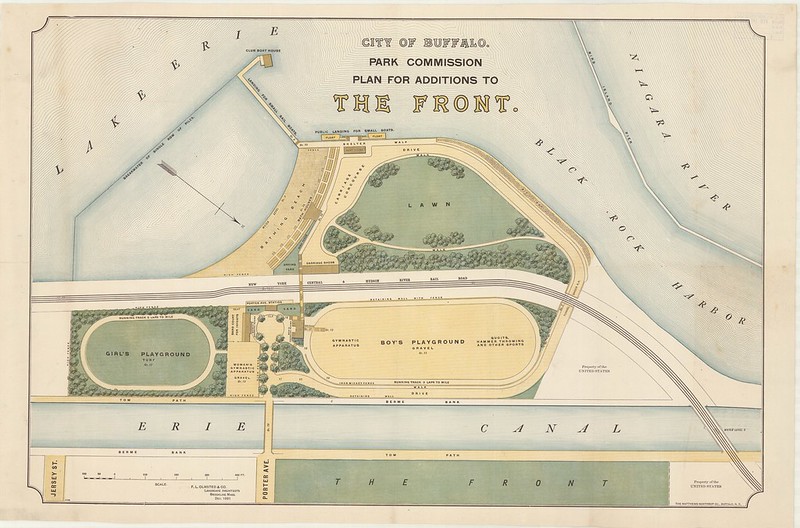
Development of the added lands at the Front to Olmsted’s design was never completed. A number of changing huts were installed at the beach area. Dumping was allowed on a good portion of the added grounds, in an attempt to raise the grade relative to the lake. In 1903, a new baseball diamond was built on part of those reclaimed lands. By 1921, a second diamond was added, augmented by two other diamonds on The Front proper.
A major impact on the site occurred as a result of the city’s urgent need to upgrade its water source. Although the Park Commission for several years had resisted the city’s desire to use park land rather than purchase private lands, the city finally prevailed. The southern section of the Front addition was acquired from the Parks Commission in 1908 as the site for what is now the Col. Ward Pumping Station and water filtration plant. That also necessitated the relocation of the Buffalo Yacht Club clubhouse, and the removal of the bathing huts to allow construction of the tunnel bringing water from the lake inlet to the pumping station. Rather than re-implementing a bathing beach, a swimming pool was constructed off Jersey street, near the pumping plant, about 1913.
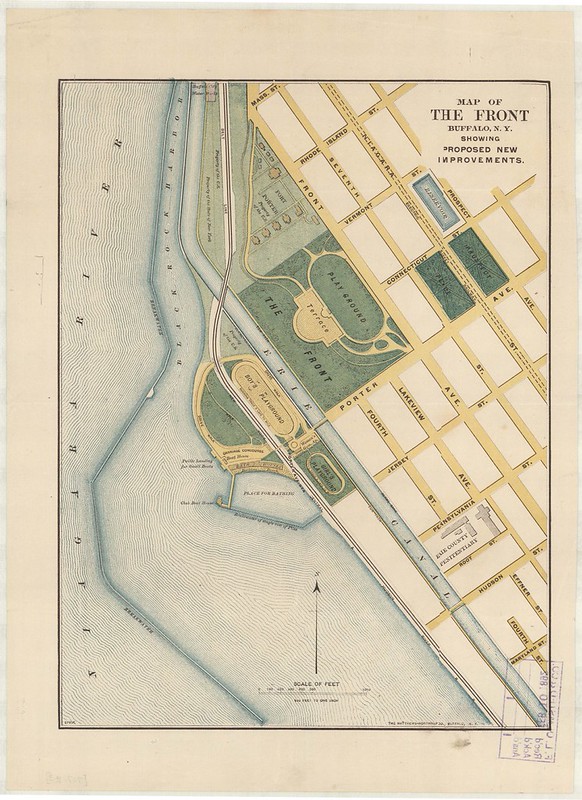
The construction of the New York State Thruway in 1954 ended the park use of the Front addition. Today, viewing the area, one would have no idea that the area was intended as a beautiful and useful playground.
260418